An equation says two expressions have the same value. In 3x + 4 = 19, x stands for a number we need to find: three times that number, plus 4, equals 19. Adding or subtracting the same amount on both sides keeps them equal. So does multiplying or dividing both sides by the same nonzero number.
For these two-step equations, undo the operations in reverse order. In 3x + 4 = 19, x was multiplied by 3 and then 4 was added. Subtract 4 from both sides to get 3x = 15. Then divide both sides by 3 to get x = 5.
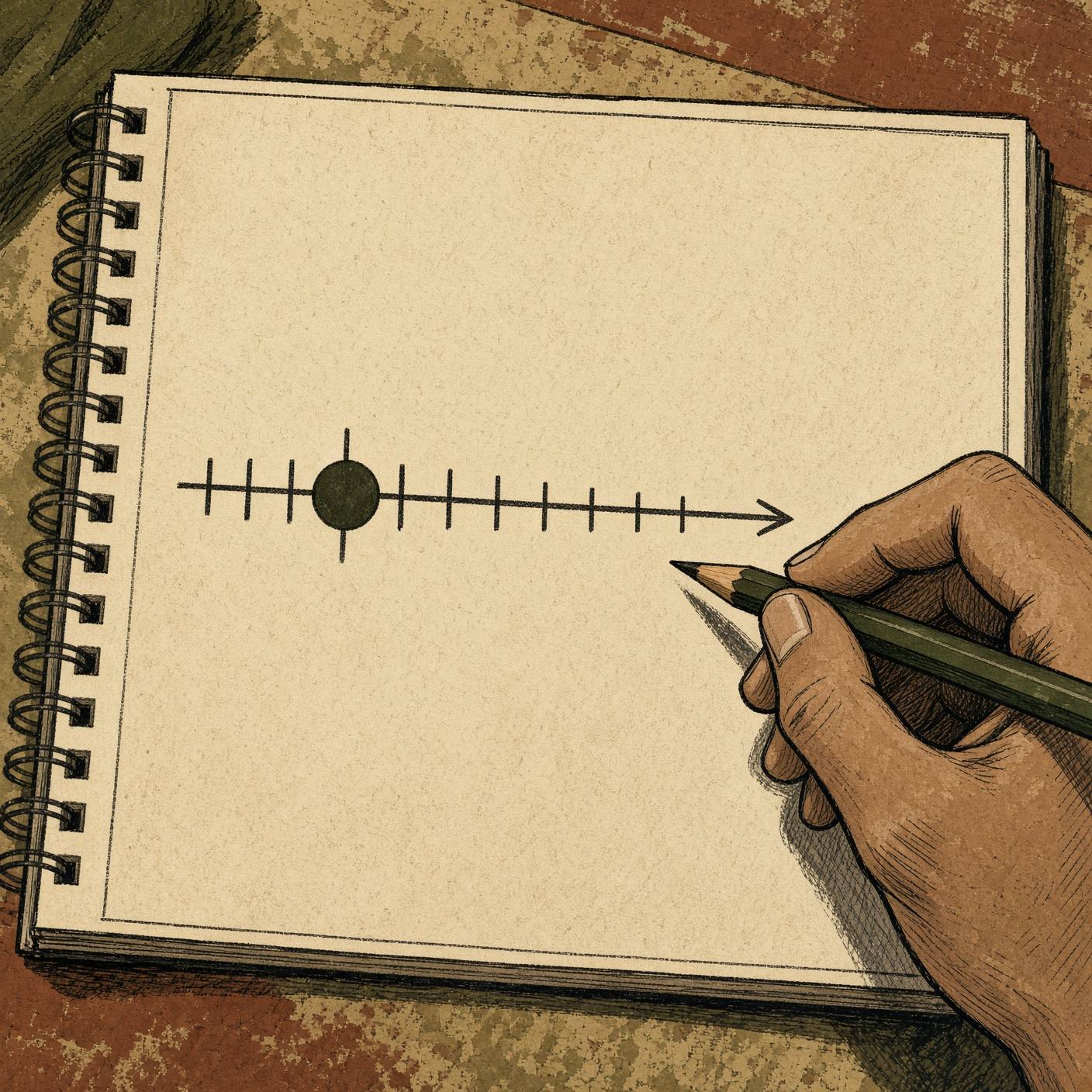
An inequality compares two values: < means less than, > means greater than, ≤ means less than or equal to, and ≥ means greater than or equal to. When you multiply or divide both sides by a negative number, reverse the inequality symbol: < becomes >, and ≤ becomes ≥ (and the other way around). For example, 2 < 3, but multiplying both sides by −1 gives −2 > −3. On a number line, a filled dot includes that number; an open dot leaves it out.
A triangle’s three angles add to 180°. Complementary angles add to 90°. Supplementary angles add to 180°. Write that as an equation, then undo it.