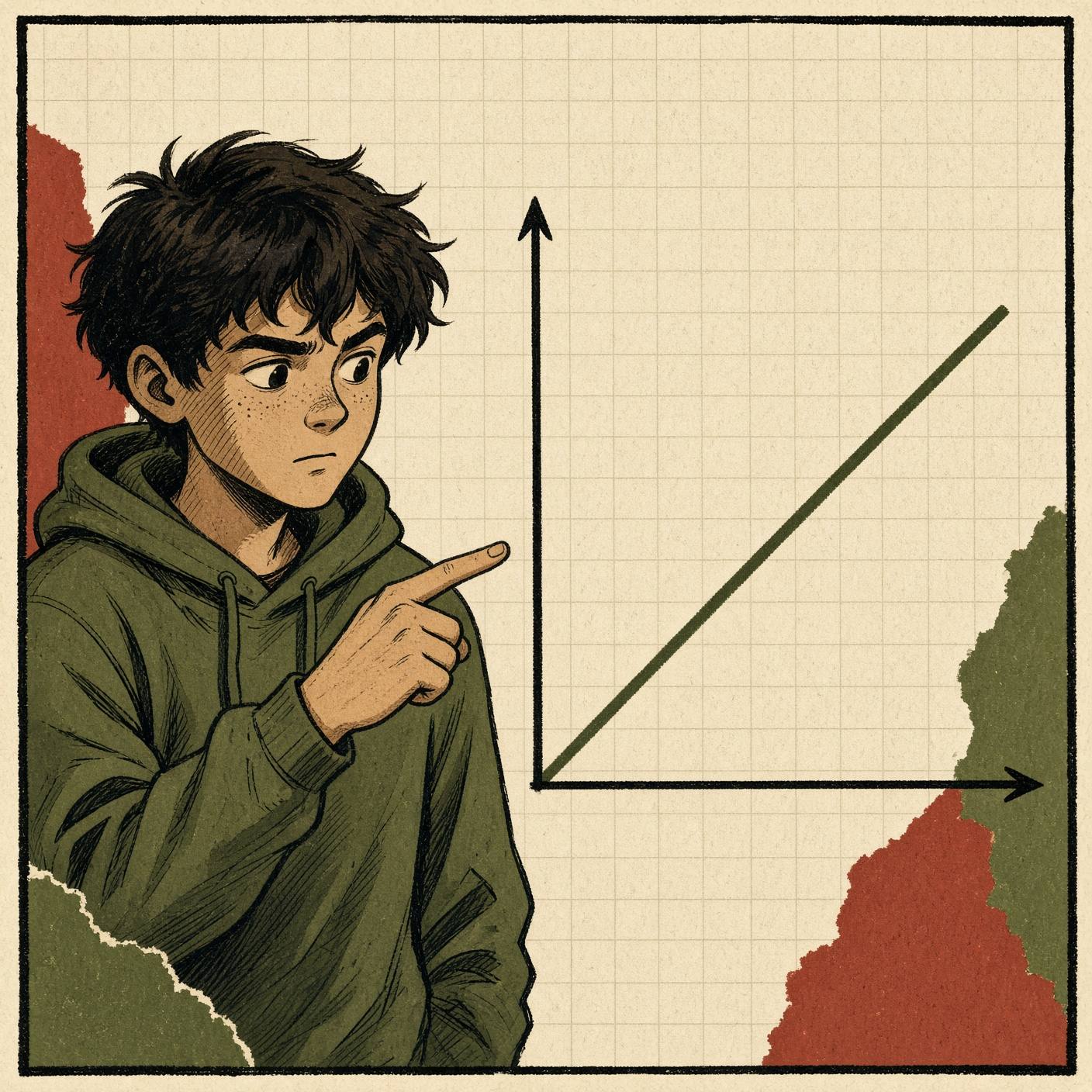
At a constant speed, twice as much travel time means twice as much distance. Distance y is always the same number times time x: y = kx. We call this a proportional relationship. The multiplier k is the constant of proportionality. Find it with k = y ÷ x. For 60 miles in 2 hours, k = 60 ÷ 2 = 30 miles per hour. Use a pair where x is not zero, because division by zero is not defined.
Same story, four outfits. A sentence (“$14 per hour”), a table, a graph, or y = kx. k is just the unit rate: how much y you get for one x.
A proportional relationship has a straight-line graph through the origin, (0, 0), where both coordinates are zero. A straight line that misses this point is not proportional. For example, a taxi that charges a starting fee already has a cost when the distance is zero.
d = r × t is the same idea for travel: distance = speed × time. Same skeleton as y = kx.