Back to Proportionality

The number that never changes

At a steady speed, double the hours and you double the miles. Divide miles by hours to find the rate, k.

PracticeSolution key

In plain words

At a constant speed, twice as much travel time means twice as much distance. Distance y is always the same number times time x: y = kx. We call this a proportional relationship. The multiplier k is the constant of proportionality. Find it with k = y ÷ x. For 60 miles in 2 hours, k = 60 ÷ 2 = 30 miles per hour. Use a pair where x is not zero, because division by zero is not defined.

Same story, four outfits. A sentence (“$14 per hour”), a table, a graph, or y = kx. k is just the unit rate: how much y you get for one x.

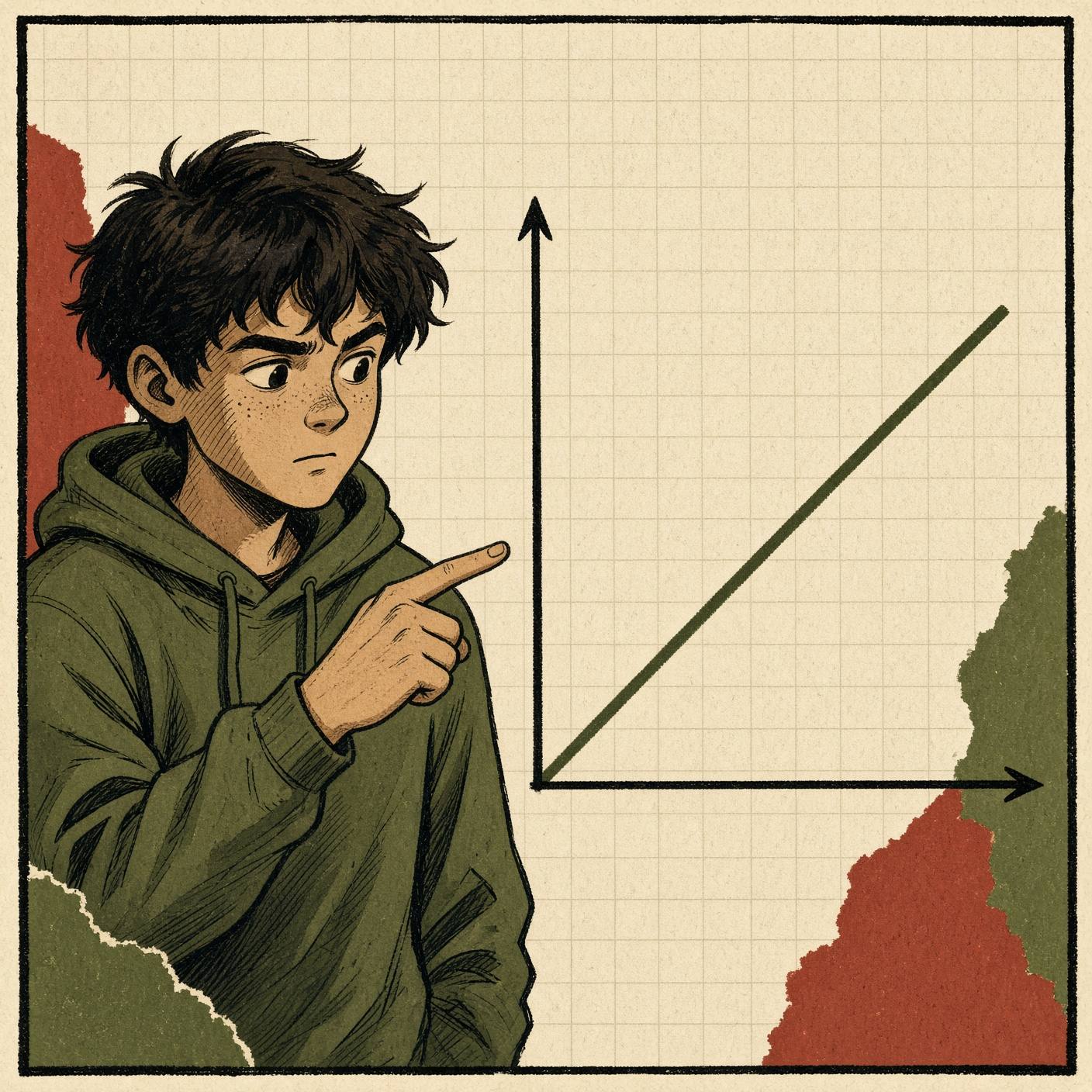
A proportional relationship has a straight-line graph through the origin, (0, 0), where both coordinates are zero. A straight line that misses this point is not proportional. For example, a taxi that charges a starting fee already has a cost when the distance is zero.

d = r × t is the same idea for travel: distance = speed × time. Same skeleton as y = kx.

Examples

Try it. Then open the steps.

Example 1 of 5

The copy shop

Copies cost $0.12 per page. Write k, then the equation for cost y after x pages.

Example 2 of 5

The table

Assume y is proportional to x. A table shows x = 2, 4, 6 and y = 10, 20, 30. What is k?

Table. Columns: x, y, y ÷ x. Rows: 2, 10, 5; 4, 20, 5; 6, 30, 5.
xyy ÷ x
2105
4205
6305

Example 3 of 5

Does it pass?

A graph of distance vs time is a straight line through (0, 0) and (3, 90). Find k.

Straight-line graph. Horizontal axis hours, from 0 to 4. Vertical axis miles, from 0 to 120. Marked points: (0, 0); (3, 90). The line passes through the origin, the point (0, 0).

Example 4 of 5

The soccer tickets

Two friends in the stands

Tickets are $18 each, no extra fee. Cost y for x tickets. What is k, and what is the cost of 7 tickets?

Example 5 of 5

The cricket run rate

Dad checking the scoreboard

A cricket team scores 48 runs in 8 overs at a constant rate. Runs are cricket’s points; an over is a set of six valid balls bowled. Let y be runs and x be overs. What is k, the runs per over?

Things to watch for

  • Easy to miss: Dividing x by y when the equation is y = kx.

    Do this: Divide y by x, using x ≠ 0. If y is miles and x is hours, this gives miles per hour. Dividing hours by miles gives time per mile instead—a different rate.

  • Easy to miss: Calling every straight line proportional.

    Do this: The straight line must pass through the origin, (0, 0). A starting fee means the cost is already above zero before anything is bought, so that cost relationship is not proportional.

26 problems · Camp, Trail, Summit